
What is a Russian oligarch?
The use of the term “oligarch” or “oligarchy” in the Russian context speaks to debates about the very nature of the Russian political system. Historians and political scientists have long described Russia as oligarchic.The problem with using the term oligarch, however, is that its usage has changed repeatedly since Soviet times. Today, it seems to be much more about power than anything else.
The term “oligarch” is applied so flagrantly to Russians, it is hard to tell where Russia’s oligarchy begins and ends, who exactly inhabits this coterie and what ring do the oligarchs orbit around Vladimir Putin. Indeed, the meaning of the word oligarch is difficult to separate from Russia. According to the Oxford English Dictionary an “oligarch” means “a very rich business leader with a great deal of political influence”. Though this definition could easily apply to most countries, the OED added a curious addendum: “Especially in Russia.”
October 4, 2017 -
Sean Guillory
-
AnalysisIssue #5/2017Magazine
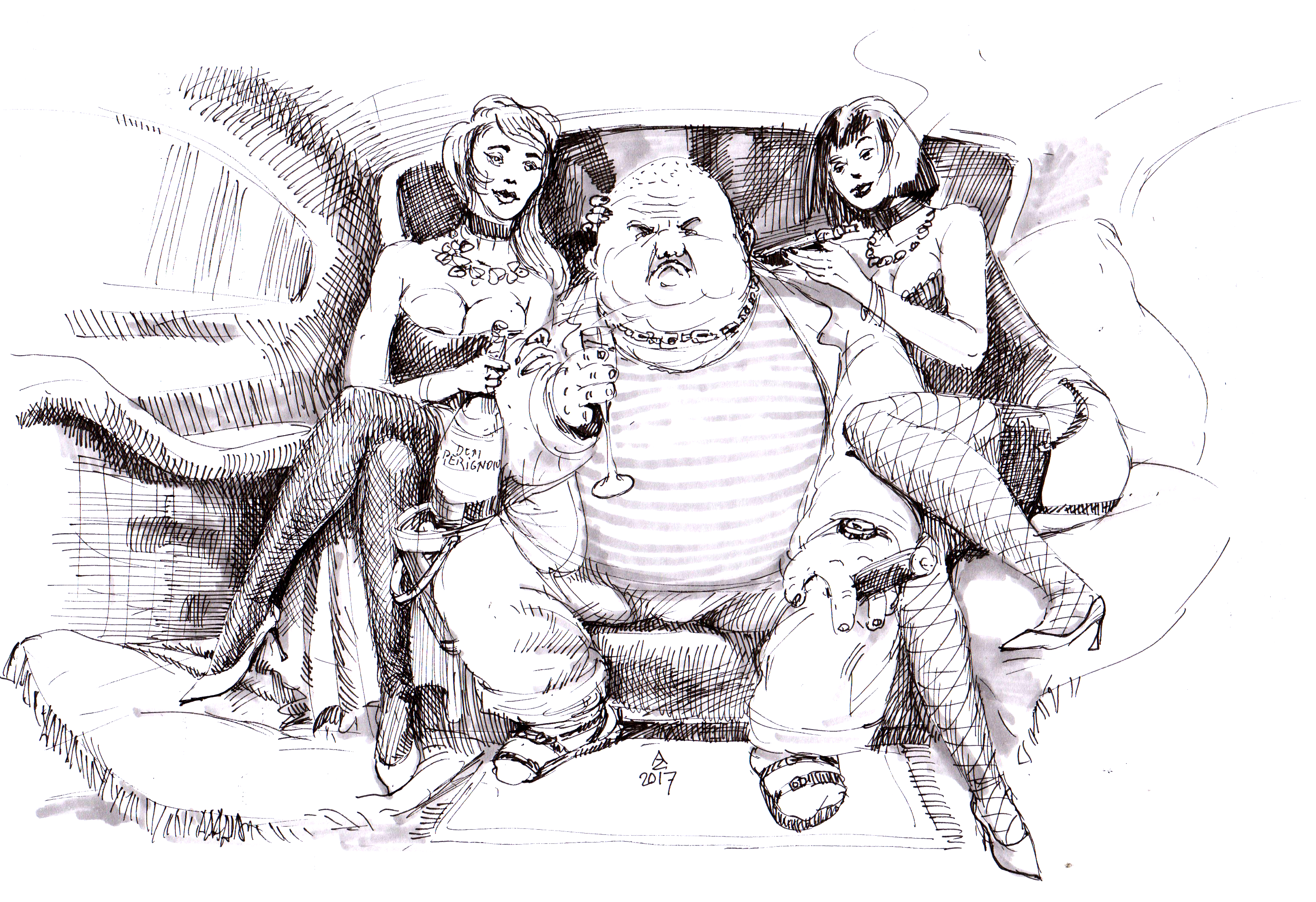
Illustration by Andrzej Zaręba
A perusal of recent news about Russia obscures more than it reveals. Russian oligarchs have become a pervasive spectre. US President Donald Trump’s former campaign manager Paul Manafort was in business with “Russian oligarch” Oleg Deripaska. Jared Kushner, Trump’s son-in-law and advisor, had a multi-million dollar real estate deal with a “Soviet-born oligarch”. Donald Trump Jr’s scandalous meeting with a Russian lawyer was brokered by “Russian oligarch” Aras Agalarov. The major shareholder of the Bank of Cyprus, the “Russian oligarch” Dmitry Rybolovlev, bought real estate from Trump. “Russian oligarchs” have become so emblematic of Russia, Stephen Colbert, a US comedian and host of the popular Late Show, recently adopted the “relaxed oligarch look” with “Russian oligarch” Mikhail Prokhorov to learn how to roll like a “Russian oligarch”.
Homo oligarcha
The problem with the term oligarch as a figure in Russian politics is that its usage has changed repeatedly since Soviet times. Confusion springs from its two often inseparable elements: wealth and political influence. While oligarchs are ideally both, many commentators on Russia need only identify a figure with either wealth or political power, but not necessarily both.
The instability of the meaning of oligarch has led some to question its existence. Writing in 1998, economist Anders Aslund argued the oligarchy in Russia was “largely a media phenomenon” because oligarchic wealth was not as concentrated as many assumed. Just a few years ago, journalist and author Masha Gessen emphatically wrote that “there are no oligarchs anymore” because Putin had hobbled their political influence.
On the other hand, Russia expert Andrew Weiss stated that, “Russia’s oligarchy (that is, the control of the state and economy by a small group of well-placed, extremely wealthy insiders) is alive and well.” His assertion was based on the symbiosis between fortune and power. A scan of academic works on the post-Soviet Russian elite shows that oligarch is a common sociological category. But as the examples above suggest, it is also uncritically used simply to describe wealthy Russians.
What, then, is an oligarch in Russia and where did this figure originate, and how has it changed over time, if at all? The use of oligarch or oligarchy in the Russian context speaks to debate about the very nature of the Russian political system. Historians and political scientists have long described Russia as oligarchic. In his seminal essay, titled “Muscovite Political Folkways”, historian Edward Keenan challenged the prevailing view that Russia was “inherently predisposed to autocracy [and] prone to embrace tyrants”. Rather, Keenan argued that “the Muscovite, and later Russian, systems tended to prefer oligarchic and collegial rule, to avoid the single leader and to function best when the nominal autocrat was in fact politically weak”. Oligarchs, in Keenan’s formulation, were boyars and bureaucrats (who were often the same) that constrained the tsar’s power. There were periods where the autocrat “overpowered” this oligarchy, but Keenan maintained that these were exceptions to the rule.
Keenan likened the Russian elite structure to an atom. The tsar, emperor, or party secretary stood at the centre as a “fixed nucleus” encircled by concentric rings comprising of oligarchs. The relationship between the tsar and his orbiting oligarchs was symbiotic. The former acted as the arbiter over disputes and the guarantor of wealth, while the latter gave him political deference. An oligarch’s power was in relation to his proximity to the tsar. Disequilibrium periodically flared up, particularly during monarchical transitions, and oligarchic clans often jostled against each other. But for the most part, the Muscovite oligarchy maintained collective cohesion. This was especially the case in how it presented itself to the public. The “assiduous production of noise” (i.e., ceremonial pomp and circumstance), provided legitimacy for the preservation and reproduction of power and profit.
Patron-client networks
The oligarchs within the tsar’s orbit were also powerbrokers in their own right. Smaller potentates orbited them in a concentric telescope of patron-client networks that linked centre and periphery. Wealth and power was an oligarch’s motive, but amassing these was in relation to his ability to dole out favours to clients. In many ways, the power of an oligarch – even the one at the top – was always circumscribed by his clients.
The Russian state, therefore, was less the autocratic vertical as many imagined. Rather the power vertical was a façade to maintain the semblance of a unitary structure. In reality, the Russian sate was a politically fragmented entity bound by chains of patron-client networks swirling around the tsar. This model kept the Russian ruling system relatively stable, as long as there was a tsar strong enough to maintain the balance. Moments in Russia’s history where the tsar was too weak or too strong ended in catastrophe and oligarchic cannibalism.
Oligarchs, patrons, clients and clans were key devices for understanding the Soviet system. Recent scholars have even characterised Stalin’s “team” as an oligarchy. Soviet oligarchic rule was particularly visible under Leonid Brezhnev. The Soviet Union as an oligarchy, a small group at the tiptop of a broader nomenklatura, functioned as the board of directors for a wider Soviet ruling class. The party oligarchy’s purpose was to secure the nomenklatura’s status. The New York Times would describe Brezhnev in 1981 as something like an adjudicating neo-Muscovite prince: “A senior oligarch, his somewhat elevated position [was] secured by mediating between contending forces at the top of the party.” When he died in November 1982, the Times editors lamented Brezhnev’s passing almost with affection as “the oligarch we knew”.
The Komsomol economy
One story yet to be fully told is the centrality of the “Komsomol economy” in the rise of the post-Soviet business elite. Some of those who cut their entrepreneurial teeth as young communists in the mid-1980s, like Mikhail Khodorkovsky and Vladimir Vinogradov, became infamous magnates of the Yeltsin era. Others used their connections to Komsomol resources and party patronage to get rich. This history is significant not just for the emergence of the post-Soviet oligarch, but for the privatisation of the Soviet economy in general. By the time the Soviet system had collapsed, Komsomol connected co-operatives were awash with cash. The heads of these organisations set up the first banks, the means to give credit, and when the time came, the money to scoop up Soviet enterprises or loan Boris Yeltsin funds for his re-election campaign in the notorious loans for shares scheme.
The Komsomol economy developed rapidly after a series of Communist Party resolutions beginning in late July 1986 with the creation of the Youth Centres for Scientific and Technological Creativity (TsNTTM). The idea was to experiment with market reforms through a politically safe entity like Komsomol. The party pumped funds into these centres to set up co-operatives. These bodies were to support themselves by providing paid services to Soviet institutions and industries. Two years later, these centres expanded to manufacturing and refurbishing imported electronics. As Petr Zrelov, a former head of the youth co-operative Dialog, said: “After buying technology for Dialog for 80,000-85,000 roubles, we could easily sell it for 180,000 roubles. It was as profitable as trading raw materials”. A few years later, the wealthiest of co-operatives had begun hocking natural resources. Another former Komsomol, Sergei Kabaev, spoke about how the computer firm IVS rented a coal mine in 1990 in Kuzbass and “controlled 20 percent of its coal exports in the country”. The centres were allowed to keep up to 30 percent of the profits and only five percent was kicked up the Communist Party Central Committee. As sociologist Olga Kryshtanovskaya put it, “The system of Youth Centres for Scientific and Technological Creativity began enriching two groups of business men – heads of state enterprises and the leaders of the TsNTTM themselves.”
Such schemes gave Komsomol entrepreneurs the real means to generate profit: the ability to turn Soviet beznalichnye, a kind of virtual money the Soviet industry used as an accounting unit, into hard currency. Initially, it was used to buy Western products – old computer equipment, electronics, clothes, perfumes, cars, and other items and sell them for inflated prices. But TsNTTM quickly moved from traders to currency speculators and exploited the hard currency black market. As Kryshtanovskaya and Stephen White explained, “A firm might typically obtain a credit of a million dollars for a month, sell the dollars on black market for (say) 10 rubles each, and then return the credit to the state at the official rate of exchange [which was 65 kopecks to a US dollar], leaving a profit of more than nine million roubles. The first commercial banks, operating with the support of the state itself, were able to profit in the same way.” Because of this, TsNTTM were known in Komsomol circles as “locomotives of inflation.”
The party had opened the floodgates. By 1990, there were roughly 4,000 private firms and 17,000 youth co-operatives employing up to a million people. When the Soviet state legalised private enterprises in 1989, some of the largest co-operatives, many of which were directly under the auspices of local Komsomol organisations and with party patronage, began to merge into joint-stock companies. Some even had Americans as minority shareholders. One such firm, Sovinterinves, had a combined worth of four million US dollars, with American shareholders controlling 12 per cent. Many of these also were established by the relatives of high-ranking party members. There were many other schemes at the time where members of the Soviet nomenklatura used their positions to initiate the “privatisation of the state by the state” even before the Soviet system formally collapsed.
Old-new oligarchy
The term “oligarch” was used in Soviet parlance in the late 1970s and early 1980s to describe magnates in Latin American states allied with the United States. Soviet newspapers would describe workers in Peru, Panama, Argentina or Chile as fighting against “American imperialism and local oligarchs”. In the Cold War great game, oligarchs were the agents of international capital in general and the United States in particular.
By 1990, the word “oligarch” in Russian newspapers started to refer to national and local party officials and other potentates. The term didn’t take on a more economic dimension until the mid-1990s, however, when journalists began reflecting on perestroika as a time of “nomenklatura capitalism” and sound the alarm that post-Soviet Russia was quickly becoming an “oligarchy and not a democracy”.
The lack of discourse about Russian oligarchs as very rich and politically influential in these early post-Soviet years is, in part, a result of how the new elite emerged. According to Kryshtanovskaya, the privatisation of the state by the state did not create a new elite in the ashes of the old. Nor did it necessarily create a group that stood out as both a political and economic player. Rather, she argues, the Russian elite bifurcated along political and economic lines. The former held its status by virtue of its position in the state, while the latter through the control of capital. There was certainly overlap, but by the mid-1990s, the Russian elite was like a “three-layered pie”. The top layer consisted of politicians who vied for political power in the state. The middle layer housed business leaders, many of whom financed and lobbied politicians and controlled the media. The bottom layer was the private and state security services. The police not only acted as the state’s billy club, but also hired themselves out to enforce business contracts, settle disputes and even forcefully seize the property of their employer’s rivals.
When did the oligarchs emerge, then? Interestingly, oligarch was popularised by Kryshtanovskaya herself in her influential January 1996 Izvestiia article, “The Financial Oligarchy in Russia”. In it she outlined her findings on the formation of the post-Soviet business elite from “wheelers and dealers” to a consolidated class. She concluded, however, that this consolidation had given rise to a new, smaller, more powerful coterie. A class within a class. “An oligarchy has formed in Russia under the conditions of industrial regression and the progression of financial institutions. The concentration of capital occurred with banks in the leading role. Therefore, the established oligarchy is primarily financial.”
References to a “financial oligarchy” ruling Russia became standard. After 1996, the term experienced a sharp increase in the Russian media. Many western journalists too, particularly David Hoffman of the Washington Post, picked up on Kryshtanovskaya’s formulation and began reporting on “the new leading oligarchs of Russia, buccaneering bankers and industrialists who are deeply entwined with the government of President Boris Yeltsin”. Hoffman would go on to write the English language primer on Russia’s buccaneering bankers. This class within a class were not only gobbling up capital and property, particularly Russia’s commanding heights, they were buying seats in the Duma and acquiring direct influence in the Kremlin. They were even personally responsible for getting Yeltsin re-elected. They weren’t just wildly rich – they were kingmakers. But they also appealed to Yeltsin to settle disputes between them. The heads of this oligarchy were some of the most infamous figures in 1990s Russia: Boris Berezovsky, Mikhail Khodorkovsky, Mikhail Fridman, Petr Aven, Vladimir Gusinsky, Vladimir Potanin and Alexander Smolensky. In the Russian press, the period from 1996 to 1998 was referred to as the semibankirshchina, or the rule of seven bankers.
Just how much political power members of Russia’s financial oligarchy exercised has long been a matter of debate. But it appears the bankers themselves understood where they stood vis-à-vis Yeltsin. “Imagine if President Gorbachev met with some businessmen. It would be absolutely unreal because they had such a different social status!” Mikhail Fridman told Die Zeit in 1997. “The very fact Yeltsin is meeting with businessmen shows a total change in the place and role of the business community in our society. Today we hold a very prestigious place.”
Taming the Shrews
In many ways, the consolidation of a segment of the Russian elite into an oligarchy around Yeltsin reflected the norm in Russian governance. A group of powerful potentates orbited a tsar. He adjudicated their disputes and they circumscribed his power. The ruling structure was still interlocked by chains of patrons and clients. The system was corrupt and self-serving, no doubt, but it was rooted in longstanding traditions.
The meaning of oligarch in Putin’s Russia, however, underwent another shift. Though Putin came to power as a representative of the oligarchy as a class, the early years of his rule were devoted to subordinating that class to the state. “This is how I see it”, Putin said in an interview with Le Figaro in 2000. “The state holds a club, which it uses only once. And the blow connects with the head. We have not used the club yet. We have only shown it, and the gesture was enough to get everyone’s attention. If we get angry, however, we will use the club without hesitation.” The club was indeed used with the expropriation, arrest and driving out of Mikhail Khodorkovsky, Vladimir Gusinsky and Boris Berezovsky in the early 2000s. The “oligarchs” who abided by the club made themselves vassals to the state and got to keep their wealth as a result.
A new oligarchy has risen under Putin. And unlike that under Yeltsin, Putin’s oligarchy is personally tied to him. Long-time friends, family members and political allies have gotten enormously rich orbiting Putin. In many respects what Thomas Graham observed about the Yeltsin oligarchy after Russia’s financial collapse in 1998 still reigns true now during Putin era. “Contrary to widespread opinion in Russia and the West, we are not witnessing the death of the oligarchy or a radical change in the way the game of politics is played in Russia … Nothing has occurred that would threaten the link between power and property.”
At the same time, the Oxford definition for “oligarch” requires some slight revision for today’s Russia. While figures publically labelled as oligarchs are certainly wealthy, we should be sceptical as to how much actual political influence they have over the Kremlin. Sure, they most certainly lobby. Figures like Arkady Rotenberg, Gennady Timchenko and Igor Sechin have direct access to Putin’s ear. But perhaps it’s best to see these men and others of their ilk no differently than most wealthy and powerful individuals. Yet in some ways, oligarchic power in today’s Russia is closer to its Soviet precedent. Russia’s ruling oligarchy resides not so much in the economic sphere, but the political one. As Mikhail Voslesnky observed in his book Nomenklatura: The Soviet Ruling Class, for Putin’s oligarchs, that is the people who inhabit his inner circle within the Russian state, “the main thing for the nomenklatura is power. Not property, but power. The bourgeoisie is the propertied class and therefore the ruling class. The nomenklatura is the ruling class and therefore the propertied class.” The goal is power. In an egregious kleptocratic capitalist system like today’s Russia, property just falls in your lap.
Sean Guillory has a PhD in Russian history from UCLA. He hosts the SRB podcast, a weekly podcast on Eurasian politics, history and culture and blogs at www.seansrussiablog.org.