
Text resize: A A
Change contrast

Has the war really changed Ukrainians?

Three years have passed since the onset of war in Ukraine. As a result some changes have occurred in the Ukrainian mentality but questions still remain: How deep are those changes? And what would it take for a reversal in attitudes towards the West? Results from recent opinion polls may come as a surprise in an attempt to answer these questions.

October 4, 2017 - Andriy Lyubka - AnalysisHot TopicsIssue #5/2017Magazine
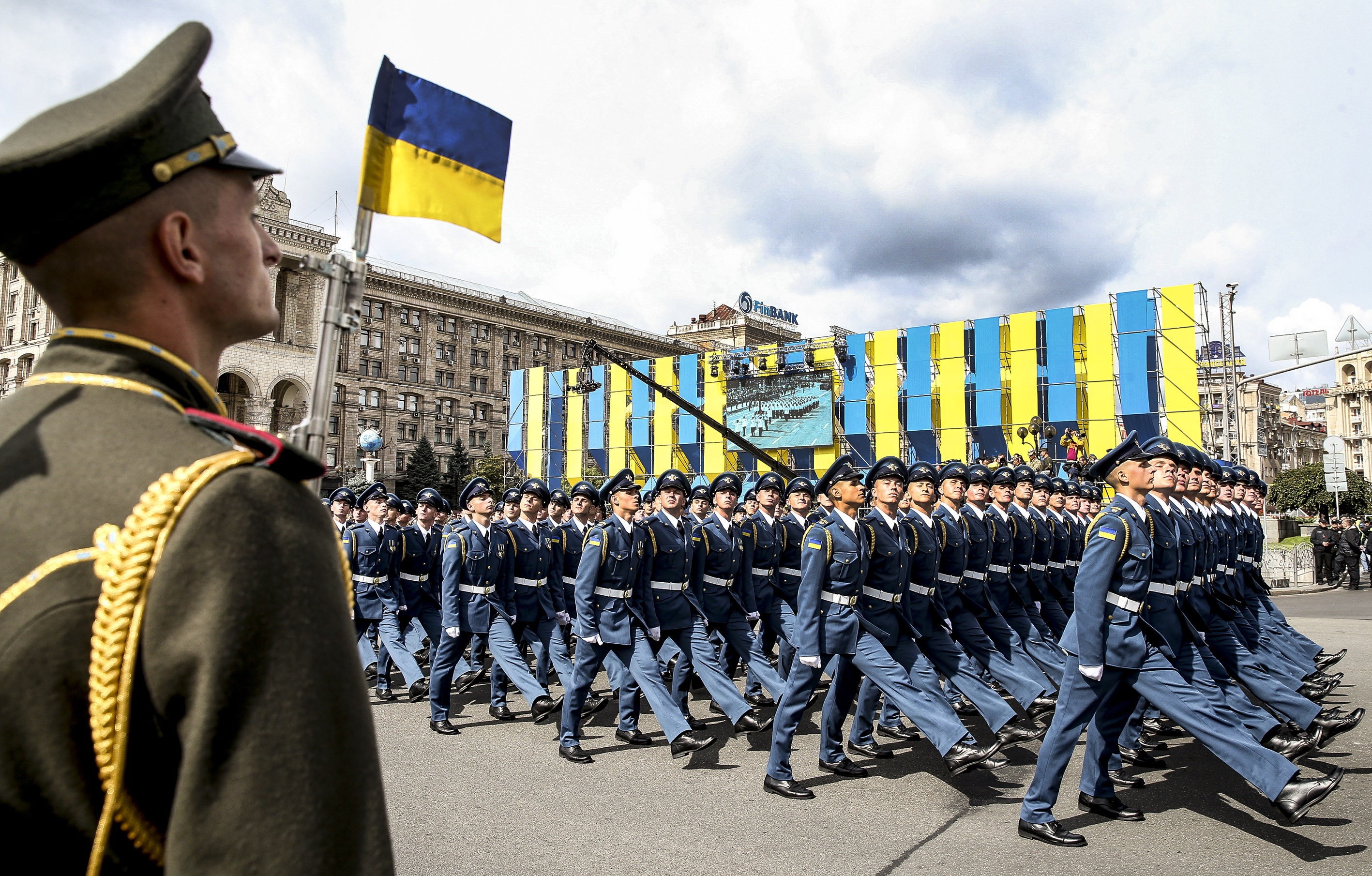
photo:(CC) Official website of the President of Ukraine

In the middle of a hot July day, a young girl hands out flyers for a travel agency at an exit of a metro station in the centre of Kyiv, advertising “Hot deals! Egypt, Turkey, Croatia – hotels without Russians!”

Since the beginning of the tourist season, Ukrainian media report about occasional conflicts between Ukrainian and Russian tourists around the world, from Peru to the Black Sea coast of Turkey. Usually one or two questions like “who does Crimea belong to?” or “what do you think of Putin?” is enough to start a quarrel or sometimes even a brawl. It is not surprising, therefore, that “hotels without Russians” are highly desirable among Ukrainians and the tourist industry has quickly responded to this demand.

The popular Ukrainian TV channel 1+1 facilitated this trend even further by reporting on a Russian couple who tried to steal shampoo, toilet paper, fruit and free alcohol from a Turkish hotel. The story received hundreds of comments, where Ukrainians laughed at Russians, criticised them for drinking and stealing everything in sight. Paradoxically, however, Ukrainians behave the same way while abroad at all-inclusive resorts, and because many of them speak Russian, it is hard to tell them apart. Within three years since the outbreak of Russian aggression, Ukrainians have certainly changed, but how deep are those changes?

Against Russia but not Russians

Social research has revealed that the attitude of Ukrainians towards Russia has changed drastically within the last decade. In 2009, almost 90 per cent of Ukrainian citizens had a positive view of the Russian Federation, while after the annexation of Crimea and the outbreak of war in Donbas in 2014 that dropped to 30 per cent. However, that percentage has been gradually increasing over the past few years. Opinion polls conducted by the Kyiv International Institute of Sociology revealed that in February this year 39 per cent of Ukrainian citizens have a positive view of Russia, and this increased to 44 per cent in May.

How is it possible, then, that attitudes towards a country which have attacked their motherland improve in recent years? There are several explanations for this, the first one being the distinction between the Russian Federation and the Russian people. This interpretation sees the dispute more as a disagreement between politicians and geopolitical matters, rather than the Russian people, who are perceived as nice and friendly. When this distinction was specified in opinion poll questions, the results were telling: only eight per cent of Ukrainians had a positive view of the Russian government, while 42 per cent had a positive attitude towards the Russia Federation and as much as 67 per cent think well of the Russian people.

The number of Ukrainians who have a negative attitude towards Russia has also decreased: from 46 per cent in February 2017 to 37 per cent in May. When analysing this data it is important to bear in mind that the surveys do not cover the territory of annexed Crimea and the occupied parts of Donetsk and Luhansk oblasts. In other words, if the surveys were conducted within these territories, the proportion of Ukrainians with a positive attitude towards Russia and the Russian people would certainly increase while the share of those who have a negative attitude would decrease respectively.

Ukrainian sentiments about breaking off diplomatic relations with Russia, introducing a visa regime or sealing off the borders are also interesting. The number of those in favour of closed borders and visas for Russians reached its climax in December 2014 (50 per cent) with only 43 per cent supporting in May 2017. Meanwhile, the number of those supporting complete open borders between Ukraine and Russia (i.e. without customs and visas) has increased (47 per cent in May 2017, compared to 42 per cent in 2014, when there was a real threat of a full-scale military invasion of Ukraine). However, a mere four per cent of Ukrainians support uniting the two powers into a single state.

Ambivalent attitude to history

While the attitude towards the present Russian government and the Russian people is directly related to the war, the view Ukrainians take towards historical figures can be illustrative of the changes in their values and mentality. It is difficult to build a liberal democracy if the citizens admire Stalin. However, according to a survey by the sociological group Rating, one in every five Ukrainians would characterise Joseph Stalin as a positive historical figure, and one in four would describe Vladimir Lenin as a positive historical figure. At the same time, Stalin and Lenin are the most negatively viewed historical figures by 75 per cent and 60 per cent of its respondents respectively.

I remember the evening of December 8th 2013, when news broke at the Maiden that the Lenin statue in the centre of Kyiv was pulled down (a ten-minute walk from the Maidan). I rushed to see a very unusual sight: a large rally gathered around the already toppled statue. An absolute majority of protesters were against Lenin and communism while others believed that monuments should not be destroyed because they still were a part of our history; they believe that a better solution would be to move the statue from the city centre to a museum. In any event, the statue of Lenin was quickly demolished with sledge hammers and I picked up a small piece of the marble monument as a souvenir. I left it at my mother’s home, but she secretly threw it away the following day. In response to my irritation, she simply replied: “It is an evil spirit. Such things should not be at home.”

This scene is very illustrative of the ambivalence that Ukrainians have about historical figures. For example, 52 per cent of Ukrainian citizens have a positive view of Hetman Ivan Mazepa (a 17th century historical figure) while at the same time 50 per cent of Ukrainians think that Mazepa’s main enemy, Russian Emperor Peter I, was a positive figure. Another example is the controversial leader of the Organisation of Ukrainian Nationalists, Stepan Bandera: 46 per cent of Ukrainians view him negatively, 35 per cent view him positively, and 18 per cent are undecided. It should be noted that the number of Bandera’s supporters has increased over the last few years: in 2012 he was viewed favourably by 22 per cent and now his support has reached 35 per cent. The reason behind this growth is the war with Russia, as OUN and UPA are the forces that had fought against the Soviet Union in the first place according to Ukrainian historical memory.

In this regard, the data on how Ukrainians support the de-communisation process, in particular renaming cities, streets and companies (for example, even the current President of Ukraine, Petro Poroshenko, owned a factory named Leninska Kuznia) is particularly interesting. More than half of Ukrainians (57 per cent) do not support the general de-communisation, while 34 per cent support renaming only those streets and cities which were named after Soviet leaders who had committed crimes against Ukraine and whose guilt can be proven. For instance, Dnipropetrovsk, a Ukrainian city with more than one million inhabitants, was originally named after Grigory Petrovsky who was involved in the Holodomor (the Great Famine) in Ukraine. The city was renamed Dnipro in 2016.

In general, the geographical component is also present in the attitudes Ukrainians have towards historical figures: Mazepa and Bandera, for instance, have more supporters in the west of the country while the east favours Lenin and Peter I. However, this divide is gradually dissolving due to demographic factors. According to surveys, younger and better educated citizens are more likely to support Ukrainian historical figures, de-communisation and integration with Euro-Atlantic structures.

Shallow changes

According to a May 2017 opinion poll, half of Ukrainians believe their country should move towards EU membership and one in three support the idea of being equally distant from the EU and Russia (12 per cent favoured joining with the pro-Kremlin Customs Union). The NATO Alliance sees slightly lower support with only 43 per cent supporting Ukraine’s accession to NATO and one-third against it, with 14 per cent of respondents undecided. Visa-free travel to the EU is considered personally important by 40 per cent, but it will not affect the lives of 55 per cent. People living in western Ukraine and younger respondents are more enthusiastic about the possibility of traveling to the EU without visas, while older respondents and pensioners are on the whole more indifferent to the development.

Based on the above, one could draw optimistic conclusions about Ukraine and Ukrainians. Despite the war, Ukrainians have not succumbed to hatred: younger and better educated citizens are more supportive of Ukrainian independence, European integration and NATO and are happy about visa-free travel. However these conclusions do not fully reflect the values system of Ukrainian society.

For instance, according to the Rating survey, as many as 38 per cent of Ukrainians are in favour of introducing the death penalty (47 per cent are against) and one in four supports a ban on abortion. Interestingly, support for the death penalty and a ban on abortion are most popular in the west of Ukraine (i.e. the region which also has the highest level of support for European integration). For Ukrainians, European integration means the process of rapprochement with the EU, which involves profound reforms, fighting corruption and establishing rules for the free market. At the same time, however, more than half of Ukrainians oppose open privatisation of land and 63 per cent believe that co-operation with the International Monetary Fund has increased poverty rates in Ukraine.
Therefore, Ukrainians can take to the streets to demand democracy, European integration and radical reforms, but at the same time they favour Belarus over all other countries (60 per cent), which can hardly be called an example of the rule of law and freedom. Ukrainians may demand a free market economy, but they also support state paternalism in economic and social policies. Ukrainians have always been ambivalent, and the war has only emphasised this feature of their mentality.


Both Ukraines move to the West

Some discrepancies in attitudes to the past and the direction of the country’s development do not lead to internal conflict and disjunction. On the contrary, following some changes in the value paradigm and the Ukrainian mind-set, there is a period when the new and the old co-exist in people’s minds. It is hardly surprising then that the young are more in favour of the European integration and the elderly prefer open borders with Russia.

Compared to 2014, when global media were dominated with maps exposing divisions in Ukrainian society based on the language spoken (Ukrainian/Russian) and geopolitical preferences (pro-western/pro-Russian), which were reflected in the maps of presidential elections (Yanukovych/Yushchenko, Yanukovych/Tymoshenko), the situation does not seem so straightforward today. Firstly, despite his openly pro-European agenda, Petro Poroshenko won the presidential election in all parts of Ukraine, including the east and the south of the country.

Two-thirds of Ukrainians are against the Russian language being officially used and one-third is in favour of it. However, this does not mean that regional differences have disappeared. There are still more Ukrainian-speaking and pro-European citizens in western Ukraine and a majority Russian-speaking population with pro-Russian sentiments in the east. Nevertheless surveys carried out in the last several years show a clear and indisputable tendency: all regions in Ukraine are moving in the same direction. Although the war could have divided society and aggravate internal controversies, it has in fact accelerated the integration process. The conclusion is simple, even if there were the so-called “two Ukraines”, they have both moved to the west. One is rushing, the other is strolling; yet they are both going in the same direction.

Here is a simple example. After the beginning of the Russian aggression, the pro-Russian sentiment could have increase in the east and the south of Ukraine, while the pro-European could have increased in the west. This is generally the scenario envisaged by the Kremlin, which counted on creating greater internal divide and attempted to cause an outbreak of a real civil war. Instead, the opposite happened. The number of Ukrainians favouring independence and European integration increased in every region. The numbers are still different, but it should be emphasised they are moving in the same direction. And as the movement is greater among younger generations, we can expect Ukraine to move closer to the West in time, as generations change.


Knocking on the West’s door

Three years since the beginning of the war some changes have occurred within Ukrainian mentality, but those changes can hardly be called deep and permanent. While the annexation of Crimea and the armed conflict resulted in a less positive attitude towards Russians and in turn a more positive attitude towards the West, any developments of the geopolitical game may similarly influence the views of Ukrainians. We have a dream – to move towards the West and become part of Europe, which also means membership in the European Union. If we are denied this dream, it may lead to a dramatic change in the public mood.

At the EU-Ukraine summit in the middle of July this year, no final declaration was adopted. It was blocked by several countries led by the Netherlands, as they were opposed to any official support of Ukraine’s European aspirations, not to mention any prospects of EU membership. Before, Ukrainians had certain milestones on the way to achieving this dream: the signing of the Association Agreement with the EU (which triggered the revolution) or the granting of visa-free travel. However, there currently lacks a subsequent milestone. And there are concerns that without further progress towards something tangible, a new wave of disappointment and discontent may pass over Ukraine.

The example of Turkey has demonstrated that long and fruitless waiting for real convergence with the EU may drastically change the public mood and pave the way to authoritarianism. Knocking on a door that was closed in your face is humiliating. One only needs reminding that our last revolution was dubbed the Revolution of Dignity.

Translated by Olena Roguska

Andriy Lyubka is a contemporary Ukrainian poet, writer and essayist.

, , , ,

Partners

Terms of Use | Cookie policy | Copyryight 2025 Kolegium Europy Wschodniej im. Jana Nowaka-Jeziorańskiego 31-153 Kraków
Agencja digital: hauerpower studio krakow.
We use cookies to personalise content and ads, to provide social media features and to analyse our traffic. We also share information about your use of our site with our social media, advertising and analytics partners. View more
Cookies settings
Accept
Decline

Privacy & Cookie policy
Privacy & Cookies policy
Cookie name Active
Poniższa Polityka Prywatności – klauzule informacyjne dotyczące przetwarzania danych osobowych w związku z korzystaniem z serwisu internetowego https://neweasterneurope.eu/ lub usług dostępnych za jego pośrednictwem Polityka Prywatności zawiera informacje wymagane przez przepisy Rozporządzenia Parlamentu Europejskiego i Rady 2016/679 w sprawie ochrony osób fizycznych w związku z przetwarzaniem danych osobowych i w sprawie swobodnego przepływu takich danych oraz uchylenia dyrektywy 95/46/WE (RODO). Całość do przeczytania pod tym linkiem
Save settings
Cookies settings