
In Russia’s near abroad, storylines matter
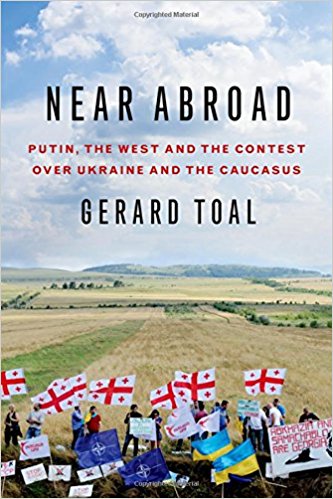
A review of Near Abroad: Putin, the West, and the Contest Over Ukraine and the Caucasus. By: Gerard Toal. Publisher: Oxford University Press, United Kingdom, 2017.
October 4, 2017 -
Joseph Larsen
-
Books and ReviewsIssue #5/2017Magazine
Students of international relations often assume that cynicism governs affairs between states. Governments are guided by strategic and economic interests. Values, ideologies and rhetoric are thin veneers applied to the rough texture of real politics. Gerard Toal, a professor of geography at Virginia Polytechnic Institute, invites us to consider whether such assumptions are wrong. What if states and the people who lead them actually believe the stories they tell about their societies and the roles they play in the world?
That idea is central to Toal’s latest book, Near Abroad: Putin, the West and the Contest Over Ukraine and the Caucasus. The author analyses Russia’s recent invasions of Georgia and Ukraine, while making the compelling argument that rhetoric is much more than a smokescreen: leaders are guided by “affective geopolitics” – i.e., the way they feel about the surrounding geopolitical environment. Stories, narratives and myths affect international relations more than either liberals or realists are able to admit. In particular, storylines were central to recent Russian decisions to invade Georgia and Ukraine.
Moralised abstractions
Toal is a pioneer and practitioner of “critical geopolitics”, an approach to international relations that rejects the universality assumed by prevailing theories such as liberalism and realism. He opens the book by arguing that both strands of thought fail to explain Russian aggression toward its neighbouring countries. In portraying Russia as an anachronistic, revanchist imperial power, liberals ignore details about such things as “who did what to precipitate Russia’s invasions”. Instead of considering context and analysing contingent factors, liberal commentators rely on what Toal derisively calls “moralised abstractions”.
Realists do not fare much better. Viewing Russia as a defensive actor responding predictably to NATO’s misguided encroachment onto its borders, realist commentators mistakenly assume that “superpowers are the only ones with real agency, smaller states are subordinate clients, and substate actors are proxies”. In obsessing over geopolitical struggles between Russia and the EU and NATO, realists ignore the fact that details matter. For example, why did Russia invade Georgia in 2008 but not the Baltics in 2004? Why did Russian President Vladimir Putin declare in 2002 that the question of Ukraine joining NATO was “a matter for those two partners”, only to order an invasion of Ukraine less than 12 years later?
One of Toal’s most convincing arguments is that both Russia and the United States resorted to essentially parallel storylines to explain the 2008 war in Georgia. Russia claimed it was defending a helpless ethnic minority (South Ossetia) against “a resurgent fascist nationalism that was genocidal in nature” (Georgia). Russian behaviour was motivated by the same principles as the US’s “humanitarian interventions” in Bosnia and Kosovo a decade earlier. In western circles, such claims were viewed as cynical justifications for Russia’s wars of aggression. Toal suggests that Putin and his advisors acted out of sincerity even if they aggressively violated Georgia’s sovereignty.
The US told a similar story, but with the roles reversed. Despite Secretary of State Condoleezza Rice privately urging Georgian President Mikheil Saakashvili to refrain from using force in South Ossetia, once Russia’s invasion commenced, the U S publicly declared its intention to “rally the free world in defence of a free Georgia.” Georgia, the poster child for the Bush administration’s “Freedom Agenda”, was being swallowed by an imperialist bully, and the United States had a responsibility to intervene. The interests and motivations of the South Ossetians did not fit into the storyline. Thus, while the United States and Russia were on opposite sides of the conflict – as they have been in so many others – they seemed to be following essentially the same logic.
Wag the dog
Tension between affective and strategic geopolitics is another theme central to Toal’s book. States and those who lead them are less rational and less interest-oriented than we assume. In his persuasive analysis, American support for Georgia – something which peaked during the Bush-Saakashvili years, but began earlier and has continued into the Trump presidency – owes little to Washington’s strategic considerations. Rather, it is a product of dogged lobbying by Georgia’s leaders. Mikheil Saakashvili was especially skilled at cultivating an image in Washington of Georgia as the “Israel in the Caucasus” – a freedom-loving, capitalism-loving democracy whose people are held back by Russia’s pernicious influence. It was during that time that Georgia became a favoured cause in Washington.
During a visit to Tbilisi in 2005, George W. Bush, with all sincerity, called Georgia “a beacon of liberty for this region and the world”. The fact that Saakashvili and his United National Movement were ambivalent towards democracy – viewing it not as an end but a means for legitimising their governance agenda – was overlooked. Georgia’s cause had become America’s cause. Toal suggests that by 2008 the tail was wagging the dog. By successfully embedding his country’s own national narrative into American storylines about democracy promotion, Saakashvili put the US government in a difficult position: “The dilemma Saakashvili created for the Bush administration was indirectly pitting affective against strategic geopolitics.”
Nearly a decade later, a similar dynamic would follow Ukraine’s EuroMaidan Revolution. Members of Ukraine’s revolutionary government quickly and effectively followed a script borrowed from Saakashvili. In Toal’s words: “Couch Ukraine’s struggle within the abstract ideographs of Euro-Atlantic geopolitical culture, most especially the words ‘freedom’ and ‘democracy.’ Scale up the crisis: emphasise that the stakes are global not local. Marginalise awkward internal questions about exclusionary nationalism by externalising blame. Project victimhood, implicitly that experienced by a unitary nation (‘the Ukrainian people’). Publicly identify with Israel. Seek US financial aid, military training, advanced weapons systems, and NATO membership.”
A newly-free Ukraine was appealing for help against the forces of barbarism. Prime Minister Arseniy Yatsenyuk even referred to his country’s struggle as a war “between the dark and the light”. As Toal points out, the reality was much more complicated. Both in Georgia and Ukraine, domestic leaders developed national narratives that were “clearer than the truth”. Here, Toal’s argument is difficult to untangle. Both the US and Russia, he says, were motivated more by affective geopolitics than strategic calculations. However, his analysis of Saakashvili’s Georgia and post-Maidan Ukraine concludes that these states were shrewd, carefully positioning themselves within Washington’s affective storylines. It’s worth asking: Were Georgian and Ukrainian leaders less susceptible to affective geopolitics? If so, why? Rather, was it that, in the process of lobbying for western support, Georgian and Ukrainian leaders came to believe their own stories? To these questions, Toal does not provide clear answers.
Soviet legacy
Near Abroad takes aim at the affective storylines expressed by competing actors in both conflicts. The author’s critique of legalistic notions of territorial integrity, as applied in the post-Soviet space, is central. Toal’s analysis elevates “the contingent and contextual over the moral-legal” with the result being a scathing criticism of the parcelisation of Soviet territory into sovereign states after 1991. That process, carried out via the legal doctrine of uti possidetis (“as you possess”), resulted in the modern successor states to the Soviet Union. It is also the implicit bugbear of Toal’s book. The process, which he calls “legal fiction”, created newly-sovereign states marked out by borders established and altered at the whims of Soviet leaders.
In Toal’s view, the results were largely arbitrary and devoid of context: Chechnya became part of the new Russian state while Crimea, Georgia and Kazakhstan were left outside. By severing the ties of history, culture, economics and infrastructure, ethnic strife and state failure were likely to follow. Outcomes in Georgia and Ukraine owe much, Toal argues, to Soviet nationality policy and the clumsiness of post-Soviet state building. It is a failure of imagination to blame the conflicts solely on Russia.
In Toal’s critical geopolitics, nothing is sacred except the scholar’s responsibility to critique. The book takes aim at a number of well-worn western tropes about the conflicts in Georgia and Ukraine. Many readers will find his analysis distasteful or offensive. Some will accuse him of explaining away Russia’s bad behaviour. Such criticisms, however misguided, are understandable. The battle lines have been drawn and most western foreign policy practitioners and commentators support Georgia and Ukraine, even if that means overlooking certain details and local complexities.
In sum, this book is thorough, academically rigorous and provocative. Toal asks a number of questions worth asking. Perhaps the most engaging one is the following: what if Russia and the United States are at odds not because their geopolitical cultures are so different, but because they are so similar?
Joseph Larsen is an analyst at the Georgian Institute of Politics in Tbilisi, Georgia.